
The ACE901003 is a high-velocity, deterministic hardware accelerator engineered for the real-time execution of a Damped Pseudo-Inverse Solver $3 \times 6$. Optimized for kinematically redundant systems, the core provides a production-ready "Math-to-Silicon" architecture that transforms complex differential kinematics and regularized matrix inversions into high-frequency, bit-perfect FPGA logic.
By executing a fully unrolled Damped Least-Squares (DLS) sequence—spanning parallelized Normal Equation construction, Cholesky Factorization, Forward/Backward substitution, and Configuration Space Back-Projection—the core resolves non-square matrix mappings in a single, deterministic pipeline pass. This offloads recursive mathematical kernels from a system’s primary processor, providing extreme computational throughput with zero execution jitter.
The integration of an adjustable scalar damping factor ($\lambda^2$) provides numerical stabilization, ensuring robust behavior even when the underlying physical system approaches mathematical singularities. The core is engineered as a universal mathematical fabric for high-stakes, real-time automation and tracking environments. It is specifically optimized for:
The ACE901003 achieves an exceptionally lean resource utilization footprint by utilizing a symmetric lower-triangular mapping for its internal $3 \times 3$ operations, enabling dense multi-core instantiation even on budget-friendly FPGA models. The core is highly optimized for the AMD 7 Series FPGA architecture, and ACE can port the design to any customer-selected FPGA fabric or custom memory map/interface (such as AXI BRAM Controller).
xc7a100tcsg324-1.The ACE901003 is a deterministic, fully unrolled mathematical pipeline that implements a Damped Least-Squares (DLS) Pseudo-Inverse Solver for a $3 \times 6$ underdetermined system ($M=3$ rows, $N=6$ columns). Given a $3 \times 6$ Jacobian matrix $\mathbf{J}$, a 3-element task-space target vector $\mathbf{v}$, and a scalar damping factor $\lambda^2$, the core computes the regularized configuration-space correction vector $\mathbf{q} \in \mathbb{R}^{6 \times 1}$ according to:
$$\mathbf{q} = \mathbf{J}^T \left( \mathbf{J}\mathbf{J}^T + \lambda^2 \mathbf{I} \right)^{-1} \mathbf{v}$$
The underlying architecture avoids iterative solver loops, branch predictions, or runtime pivot hunting, decomposing the matrix inversion and back-projection problem into five sequentially chained hardware phases:
The first stage computes the regularized normal equation matrix in the task space:
$$\mathbf{M} = \mathbf{J}\mathbf{J}^T + \lambda^2 \mathbf{I}$$
Since the resulting $3 \times 3$ matrix $\mathbf{M}$ is inherently symmetric, the hardware fabric instantiates logic only for the 6 unique lower-triangular elements ($M_{00}, M_{10}, M_{11}, M_{20}, M_{21}, M_{22}$), using parallelized 6-tap MAC structures and injecting $\lambda^2$ directly into the diagonal accumulators to guarantee positive-definiteness even at singularities.
Once $\mathbf{M}$ is assembled, an unrolled Cholesky block decomposes it into a lower-triangular matrix $\mathbf{L}$ and its transpose $\mathbf{L}^T$. Diagonal entries ($L_{00}, L_{11}, L_{22}$) are resolved using pipelined floating-point square-root primitives, while off-diagonal entries ($L_{10}, L_{20}, L_{21}$) utilize dedicated hardware dividers without pipeline stalls.
With $\mathbf{L}$ established, the core solves the intermediate vector $\mathbf{y}$ from the input target vector $\mathbf{v} = [v_0, v_1, v_2]^T$:
$$y_0 = \frac{v_0}{L_{00}}, \qquad y_1 = \frac{v_1 - L_{10} y_0}{L_{11}}, \qquad y_2 = \frac{v_2 - (L_{20} y_0 + L_{21} y_1)}{L_{22}}$$
The core completes the task-space inversion loop by solving for the regularized weight vector $\mathbf{w}$ against $\mathbf{L}^T$:
$$w_2 = \frac{y_2}{L_{22}}, \qquad w_1 = \frac{y_1 - L_{21} w_2}{L_{11}}, \qquad w_0 = \frac{y_0 - (L_{10} w_1 + L_{20} w_2)}{L_{00}}$$
In the final phase, the stabilized task-space weight vector $\mathbf{w}$ is projected back onto the 6-dimensional configuration space via six parallelized 3-tap MAC engines:
$$\mathbf{q} = \mathbf{J}^T \cdot \mathbf{w}$$
The ACE901003 core utilizes IEEE-754 Single-Precision (32-bit) floating-point arithmetic. The equivalent software implementation is reported below:
function [q, M, L, y, w] = golden_model_dls(J, v, lambda_sq)
   % Emulates the 3x6 Damped Pseudo-Inverse hardware pipeline
   M = J * J' + lambda_sq * eye(3);

   % Manual 3x3 Cholesky (M = L * L')
   L = zeros(3, 3);
   L(1,1) = sqrt(M(1,1));
   L(2,1) = M(2,1) / L(1,1);
   L(2,2) = sqrt(M(2,2) - L(2,1)^2);
   L(3,1) = M(3,1) / L(1,1);
   L(3,2) = (M(3,2) - L(3,1)*L(2,1)) / L(2,2);
   L(3,3) = sqrt(M(3,3) - (L(3,1)^2 + L(3,2)^2));

   % Forward substitution (L * y = v)
   y = zeros(3, 1);
   y(1) = v(1) / L(1,1);
   y(2) = (v(2) - L(2,1)*y(1)) / L(2,2);
   y(3) = (v(3) - (L(3,1)*y(1) + L(3,2)*y(2))) / L(3,3);

   % Backward substitution (L' * w = y)
   w = zeros(3, 1);
   w(3) = y(3) / L(3,3);
   w(2) = (y(2) - L(3,2)*w(3)) / L(2,2);
   w(1) = (y(1) - (L(2,1)*w(2) + L(3,1)*w(3))) / L(1,1);

   % Back-projection (q = J' * w)
   q = J' * w;
end
The data below are representative of the AMD 7 series architecture. The percentages are relative to the budget-friendly xc7a100tcsg324-1:
The core runs on two different clocks:
CLK_FAST with a maximum frequency of 200 MHzCLK_SLOW that shall run at 50 MHz (phase aligned with CLK_FAST)
CLK_SLOW is used for the ACE901003 initialization, while CLK_FAST is used for all runtime operations. In the verification project, timing was closed with a robust 0.436 ns timing margin and with 0 timing violations.
The Damped Pseudo-Inverse Solver $3 \times 6$ core is packaged as an AMD IP core. Figure 1 illustrates the verification configuration.
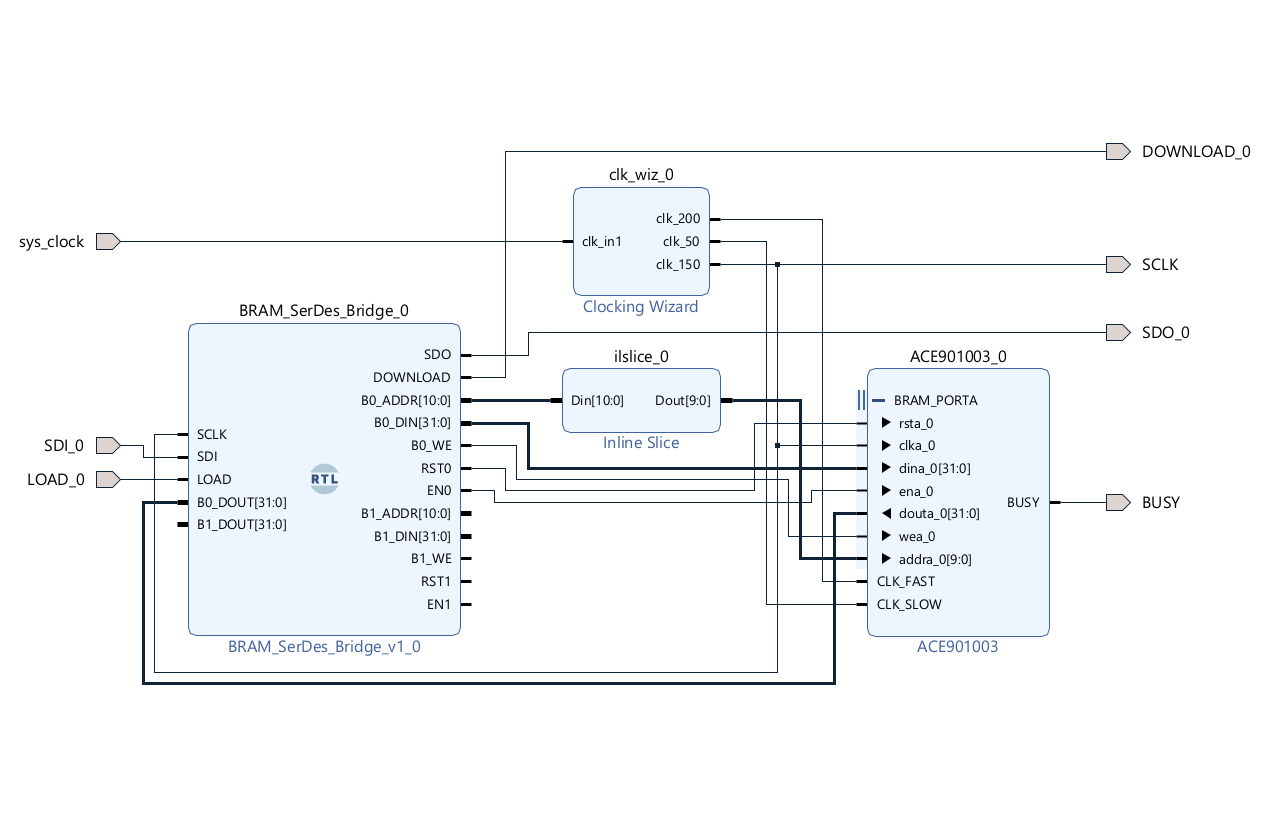
The core is fully controlled through read/write operations on a BRAM (optionally accessible via an AXI BRAM_CONTROLLER). The instantiated BRAM is 1 True Dual Port with port A available to the user and port B managed by the internal Math Engine. The BRAM has a width of 32 bits and a depth of 1024 locations. The core uses the first 51 locations (0–50), with the remaining ones completely available for the user via port A.
| ID | ADDRESS | VARIABLE | DIR | FORMAT | Note |
|---|---|---|---|---|---|
| BRAM_0 | 0 | START_CMD | IN-OUT | BINARY | Set to 0x1 by the user to start the computation. Set to 0x0 by the math engine at the end of computation. |
| BRAM_0 | 1 | DNA1 | OUT | BINARY | FPGA DNA (MSB) populated after initialization. |
| BRAM_0 | 2 | DNA2 | OUT | BINARY | FPGA DNA (LSB) populated after initialization. |
| BRAM_0 | 3 | USER_KEY1 | IN | BINARY | LICENSE_KEY (MSB) input required for validation. |
| BRAM_0 | 4 | USER_KEY2 | IN | BINARY | LICENSE_KEY (LSB) input required for validation. |
| BRAM_0 | 5 .. 22 | J00 .. J25 | IN | FLOAT32 | $3 \times 6$ Jacobian matrix elements in row-major order ($J_{00} \dots J_{05}, J_{10} \dots J_{15}, J_{20} \dots J_{25}$). |
| BRAM_0 | 23 .. 25 | v0 .. v2 | IN | FLOAT32 | Input task-space target vector elements ($v_0, v_1, v_2$). |
| BRAM_0 | 26 | lambda_sq | IN | FLOAT32 | Scalar damping factor $\lambda^2$ (regularization parameter). |
| BRAM_0 | 27 .. 32 | q0 .. q5 | OUT | FLOAT32 | Output configuration-space solution vector elements ($q_0$ through $q_5$). |
| BRAM_0 | 33 .. 50 | INTERNAL | N/A | RESERVED | DON'T TOUCH — Internal engine scratchpad registers. |
In addition to the BRAM interface, the core exposes:
CLK_SLOW is used for the initialization and for access to the DNA reader primitive ($50\text{ MHz}$)CLK_FAST is used to drive the internal computation engine (Max Frequency: $200\text{ MHz}$)BUSY pin that, when set to high, signals when the core is executing the initialization or its main function.
The core, at power-up, performs an initialization sequence that lasts (with CLK_SLOW @ $50\text{ MHz}$) less than $5,000\text{ ns}$, populating the BRAM with the DNA of the FPGA. Once initialized, the user loads the BRAM inputs and sets START_CMD to 0x1. Results are written in BRAM after exactly 508 clock cycles ($2,540\text{ ns}$ @ $200\text{ MHz}$), and the core clears START_CMD to 0x0 and sets BUSY=0.
Note: if the USER_KEY is not correct, the core terminates in the specified timeframe, but produces unpredictable results.
To validate the numerical integrity and dynamic range stability of the ACE901003 computing fabric, the hardware engine was subjected to a rigorous, 10-stage hardware-in-the-loop simulation test sweep. The verification manifest intentionally sweeps the input Jacobian matrix ($\mathbf{J}$) and target vectors ($\mathbf{v}$) across diverse operational ranges, forcing the internal regularized pipelines to calculate task-projection corrections ($\mathbf{q}$) under varying conditioning states.
As compiled in the hardware bit-fidelity verification report below, the core achieved 100% numerical equivalence with zero precision breaches across all evaluated operating envelopes. Maximum observed final $\mathbf{q}$ epsilon drift peaked at $8.21 \times 10^{-7}$ under peak stress loading near structural boundaries (Stage 10), while nominal tracking bounds routinely converged down to $1.29 \times 10^{-8}$ drift (Stage 6), demonstrating true bit-perfect mathematical propagation.
=========================================================
 ACE_3x6_JACOBIAN_SOLVER BIT-FIDELITY VERIFICATION REPORT
=========================================================
---------------------------------------------------------
 EVALUATION RESULTS FOR: STAGE_1
---------------------------------------------------------
 VERDICT: [PASS]
 Maximum Observed Final q Epsilon Drift: 1.394231e-07

 === INTERMEDIATE PIPELINE HARDWARE DUMP ===
 [PHASE 1] Innovation Matrix M (3x3):
  HW:
    9.4594   -2.6464    4.7246
   -2.6464    5.4247   -7.6601
    4.7246   -7.6601   31.5592
  GOLD:
    9.4594   -2.6464    4.7246
   -2.6464    5.4247   -7.6601
    4.7246   -7.6601   31.5592

 [PHASE 2] Cholesky Factorization L (3x3):
  HW:
    3.0756         0         0
   -0.8605    2.1643         0
    1.5362   -2.9285    4.5413
  GOLD:
    3.0756         0         0
   -0.8605    2.1643         0
    1.5362   -2.9285    4.5413

 [PHASE 3] Forward substitution vector y:
  HW: [0.45813 0.83693 0.5326] | GOLD: [0.45813 0.83693 0.5326]

 [PHASE 4] Backward substitution vector w:
  HW: [0.24296 0.54538 0.11728] | GOLD: [0.24296 0.54538 0.11728]

 [PHASE 5] Final Task Projection Vector q:
  HW:   [0.86588 0.22995 0.50119 0.29259 0.22568 0.057208]
  GOLD: [0.86588 0.22995 0.50119 0.29259 0.22568 0.057208]

---------------------------------------------------------
 EVALUATION RESULTS FOR: STAGE_6 (LOWEST DRIFT)
---------------------------------------------------------
 VERDICT: [PASS]
 Maximum Observed Final q Epsilon Drift: 1.287249e-08
 [PHASE 5] Final Task Projection Vector q:
  HW:   [-0.032355 -0.083007 -0.16098 -0.057505 0.12431 -0.26533]
  GOLD: [-0.032355 -0.083007 -0.16098 -0.057505 0.12431 -0.26533]

---------------------------------------------------------
 EVALUATION RESULTS FOR: STAGE_10 (NEAR-SINGULARITY STRESS)
---------------------------------------------------------
 VERDICT: [PASS]
 Maximum Observed Final q Epsilon Drift: 8.212565e-07
 [PHASE 1] Innovation Matrix M (3x3):
  HW:
    1.9025    0.2287    0.0656
    0.2287    3.9287    1.2973
    0.0656    1.2973    0.4652
 [PHASE 2] Cholesky Factorization L (3x3):
  HW:
    1.3793         0         0
    0.1658    1.9751         0
    0.0476    0.6528    0.1916
 [PHASE 5] Final Task Projection Vector q:
  HW:   [0.44264 0.037694 -0.33806 0.16056 0.52808 -0.31653]
  GOLD: [0.44264 0.037693 -0.33806 0.16056 0.52808 -0.31653]
=========================================================ACE901003 is delivered as a pre‑packaged Vivado IP core, ready for integration through the AMD/Xilinx IP Catalog. Each licensed core includes:
USER_KEY file for license activation
ACE provides a USER_KEY value (64 bits) for FPGA Serial Number (DNA for AMD/Xilinx). The keys are delivered in a simple CSV file:
DNA_HEX,AUTHORIZATION_KEY
0011223344556677,C303E222F7D44C5B
ABCDE1234567890F,A2A3A3114194ED74
5566778899AABBCC,94C023F594AA6F63
DEADBEEF12345678,F40237F85DFB6F2A
00123456789ABCDE,E8ACBBDBFCF3ACB7
...............,.................BRAM_PORTA interface (addresses 1 and 2).USER_KEY corresponding to the FPGA SN in the ACE provided USER_KEY file.USER_KEY via the BRAM_PORTA interface (addresses 3 and 4).
The keys are generated on customer order. In simulation, a demo DNA is used and the corresponding USER_KEY is provided in the file for a seamless experience.
Pricing is provided directly by ACE based on deployment volume, license type, optional customization requirements, and target FPGA family.
Data Privacy note: By contacting us via email, you agree that we will use your provided contact details and mathematical specifications solely to evaluate project feasibility during our early-access phase. We do not sell or share your personal information with third parties. We may use standard web analytics tools to monitor basic, aggregated website traffic to improve our site performance.