Architectural Cleanliness
In conventional FPGA design, attempting to time-multiplex a single processing block across multiple, distinct mathematical operations almost always comes at a severe performance cost. Standard toolchains and naive RTL implementations generate wide, deep multiplexer trees and complex steering logic to route data between different routines. This creates severe routing congestion, bloats control overhead, and drastically degrades maximum clock frequency often choking performance down to 100–125 MHz on low-tier silicon.
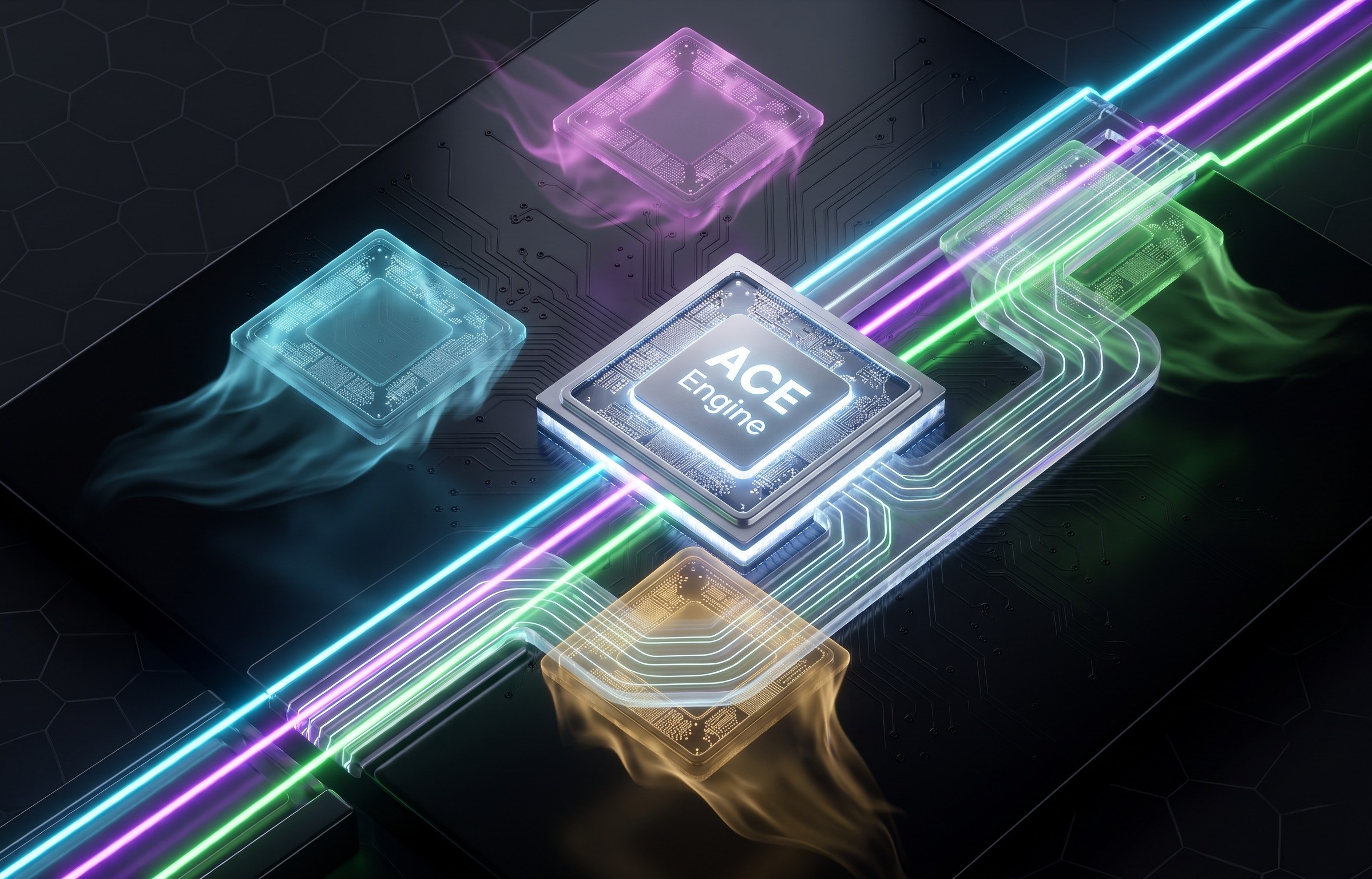
ACE technology fundamentally eliminates this multiplexing degradation.
By architecting ultra-lean, register-balanced datapaths with strictly controlled logic depth, ACE Hyper-Integrated engines keep the execution path lightweight regardless of how many routines are mapped to the hardware.
-
High clock frequency with Positive Slack: The example below shows that full timing closure with 200MHz clock is easily achieved on the lowest speed grade (-1) of entry-level AMD Artix-7 silicon, retaining comfortable timing margin.
-
Eliminated Routing Bloat: Direct, streamlined datapath routing replaces the bloated multiplexing networks that typically degrade time-shared hardware.
-
Minimal Control Overhead: Multiplexing logic is integrated so tightly that the overhead of supporting multiple routines is virtually imperceptible in both resource count and critical path delay.
-
Zero Timing Closure Pain: By maintaining high clock frequencies on standard speed grades, OEMs avoid complex floorplanning, manual layout constraints, or buying expensive high-speed silicon bins.
Effortless Integration via Standard BRAM Interface
The engine presents a standard Dual-Port BRAM interface to your system. There are no custom compilers, OS drivers, or complex bus protocols required. Your host processor or control logic simply writes input data to assigned memory addresses and triggers execution by writing a function selector code.
Technical Architecture: Simple, Memory-Mapped Execution
The Hyper-Integrated engine acts as a memory-mapped peripheral that combines multi-function mathematical execution with dual-clock memory isolation.
Executing different mathematical functions requires no hardware re-flashing or microcode loading. The host system simply writes a single function code (START_CMD) to Address 0 of the memory map:
START_CMD 1 Trigger: Runs function 1.START_CMD 2 Trigger: Runs function 2.- ...
Unified Memory Map: All inputs, intermediate scratchpad variables, and final outputs reside in deterministic, standardized memory addresses. Outputs from early pipeline stages naturally serve as inputs for later stages in the exact same memory space, requiring zero CPU data copying, bus arbitration, or DMA overhead.
Zero-Latency Resets: Multi-pass state registers (such as accumulation matrices) are automatically cleared in-line during the commit phases of companion operations, guaranteeing clean memory states for subsequent passes without extra clock cycles.